
There is a lazy but persistent habit in most professional environments, regulatory ones included, it’s reasoning by comparison. A new proposal arrives on your desk, and the instinct is to ask what it resembles, as in: where have I seen this before? Following this approach is not problematic, it’s efficient. It’s efficient because to rebuild understanding from scratch for every decision is massively time consuming, and most of the time old ways are good enough.
But there is a problem, this approach fails precisely where it matters most if the problem doesn’t map cleanly to anything that came before, or the consequences will unfold over an extended timeframe.
Fortunately, two distinct disciplines exist to correct for this failure, and they are frequently spoken of as though they were variations on a single theme. They are not. It’s first principles thinking and second-order thinking and each solves a different kind of problem, using different mental approaches. Confusing the two or assuming that using one can substitute for the other is a common analytical error.
Starting from the ground up
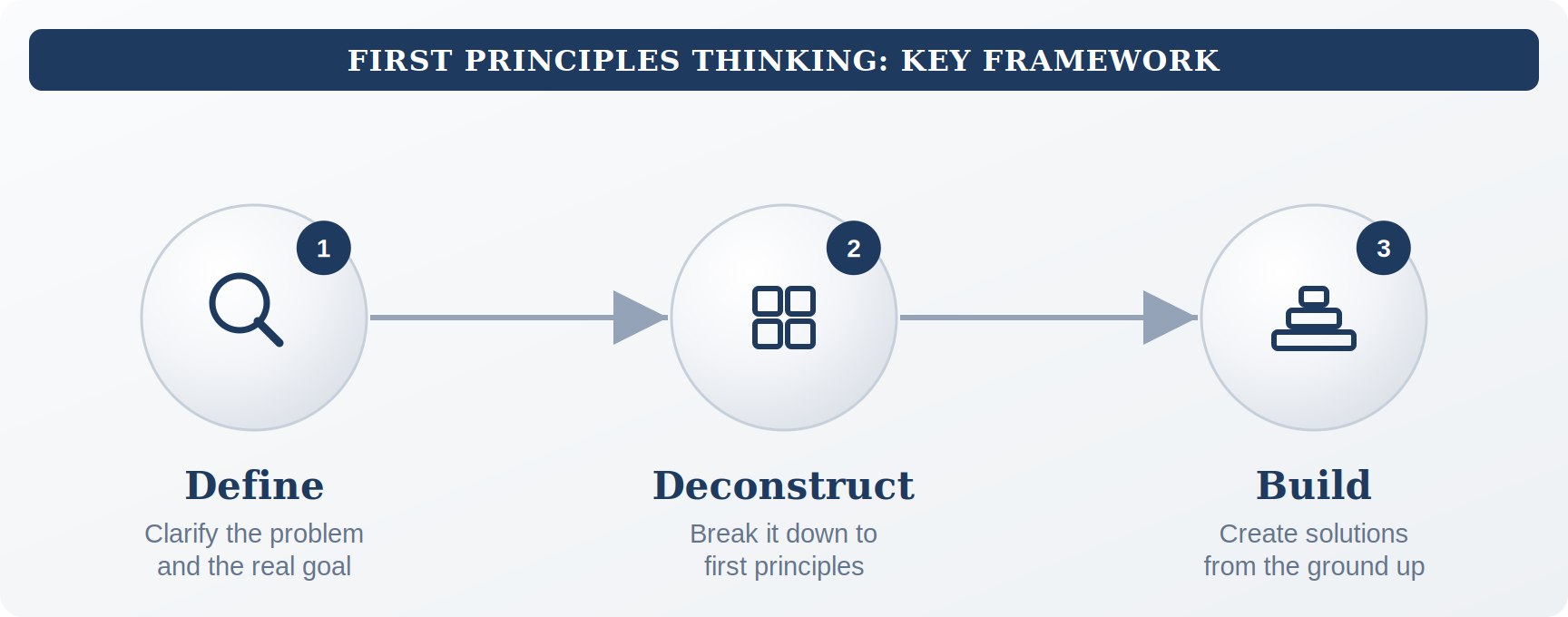
First principles thinking is fundamentally an exercise in the construction of basic parts. In the beginning of the process it should look like the problem is just a big pile of Lego blocks and have no identifiable form. First principles thinking requires you to strip a problem down to its most basic parts, until the problem’s components cannot be broken down any further. From there, you begin to rebuild your understanding from these foundation parts instead of using whatever convention or precedent just happens to be available.
This idea extends back to Aristotle, who used the term to describe the foundational truths of a discipline: the propositions that explain everything else within it but cannot themselves be derived from anything in the past.
The example that has done more than any other to popularise the concept in a business context is Elon Musk’s approach to battery costs at Tesla. The prevailing industry wisdom held that battery packs were expensive and always would be, because that was simply their historical price. Musk’s response was to ignore the industry’s framing entirely and ask what a battery is made of (cobalt, nickel, aluminium, carbon, some polymer separators, a steel can), and then to establish what those raw materials cost. The substantial difference between the raw material cost and the industry’s pricing revealed that expensive batteries stemmed from manufacturing convention and just the way things had always been done, rather than material necessity.
This is what first principles reasoning is about in practice. You need to define the actual goal, deconstruct the problem into its base components, and build a solution from those components rather than from a catalogue of existing solutions and models.
It is the natural approach when a problem does not fit into something that is known and understood, when the assumptions underlying the answer look questionable, or when the objective is to create something new rather than to refine something that already exists.
The cost to business is the slower process that requires extra effort. It’s easier to just accept an existing framework rather than interrogate the problem to create a new solution. It also carries a real risk of ignoring practical constraints that are not actually optional.
Following the consequences
Second-order thinking starts from a completely different premise. Rather than asking what a thing fundamentally is, it asks what happens after you act on it, and then what happens after that.
The concept got its clearest modern articulation from the investor Howard Marks, who distinguished between what he called first-level and second-level thinking.
 First-level thinking, in his framing, produces a single-step outcome about the future, and then stops there. A company looks strong, so buy the stock.
Second-level thinking keeps pushing past that first conclusion. It asks what the market has already priced in, how other participants are likely to react, and what the less obvious downstream effects of a seemingly good outcome might be.
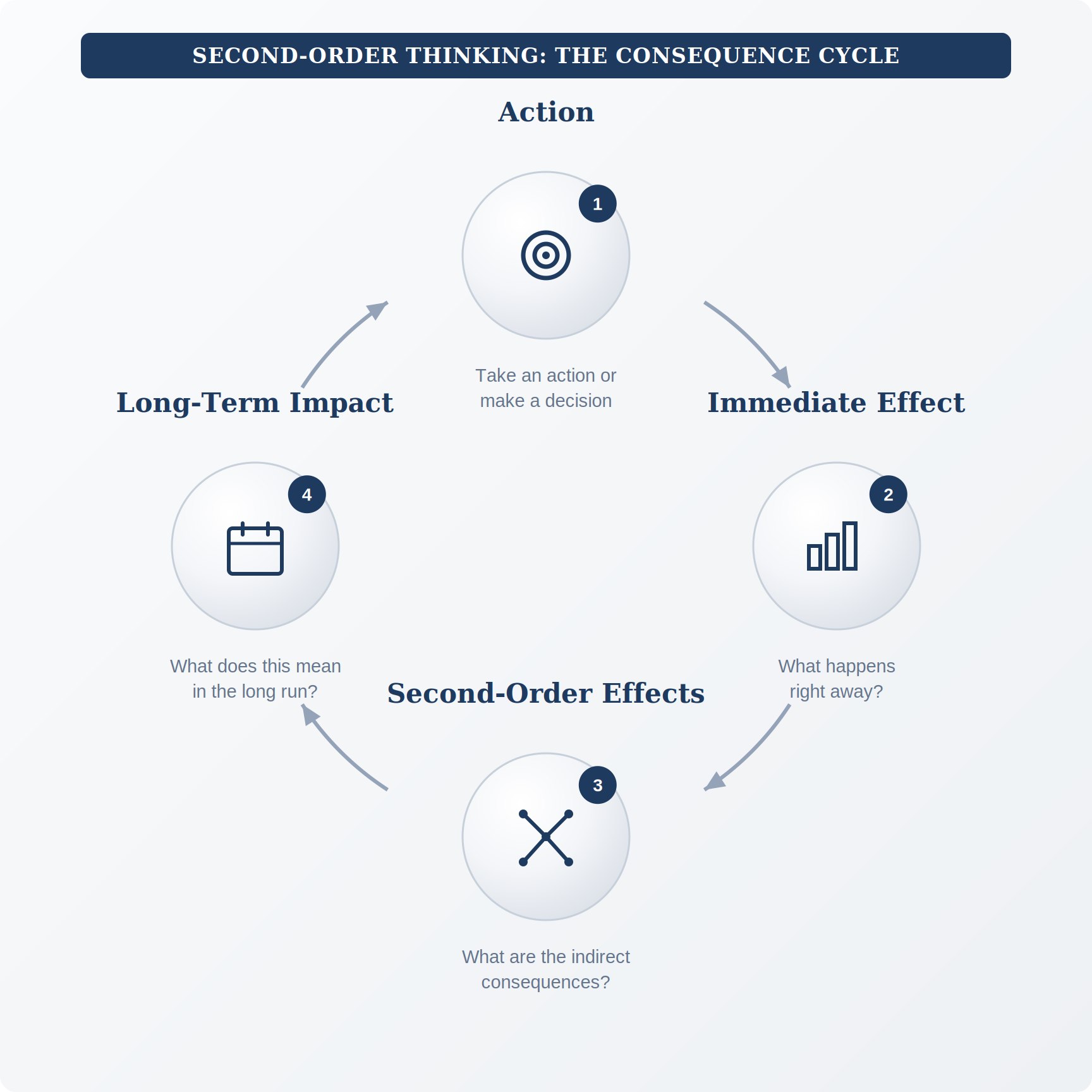
The discipline maps neatly onto a simple circular cycle. An action or decision produces an immediate, first-order effect. That effect in turn produces second-order effects that are less visible and often run in the opposite direction to the intended outcome. Those effects then ripple outward into a long-term impact that may bear little resemblance to what the original decision-maker had in mind.
The commentator Benedict Evans’s analysis of self-driving electric vehicles is a useful illustration of just how far this chain can run. The reduction in fuel consumption is the obvious first-order effect, but trace the implications further and you eventually arrive at consequences for businesses as unrelated as fuel-station-based tobacco retailing, since a large share of cigarette sales happen at the station when the driver is filling up the car with fuel.
Second-order thinking is a good fit for anything involving risk, strategy, or systems where many responses to the decision can occur, and the decision-maker does not control any of these responses.
Its potential for failure is the opposite of that for first principles. With second-order thinking, rather than stopping at a realistic outcome, the thinking can spiral out of control and into paralysis; you can end up chasing consequences of consequences until the bigger picture, and the actual decision that was in front of you get lost.
Where they meet, and diverge
The similarities between the two disciplines are enlightening. Both are effective at addressing a common failure, which is the tendency to settle for the first plausible answer, whether that answer comes from copying past practice or some other method.
They both demand more effort, and for that reason, they are actually quite rare in practice. Most people, most of the time, are first-level thinkers reasoning by comparison, which is precisely what creates room for those willing to do the harder work that may result in a better outcome.
Where they diverge is in the direction of the thinking process. First principles thinking looks backward and downward, into the foundations of a problem, in order to build something new. Second-order thinking looks forward and outward, into the consequences of a decision already made or contemplated, in order to avoid being blindsided by what the decision sets in motion. One is an architecture, the other is a forecast.
A first principles thinker asks what is actually true. A second-order thinker asks, and then what.
In practice, neither discipline alone is sufficient. Applied together, they are what separates a solution that merely looks well-reasoned on the day it is announced, from one that holds up once the world has had time to react to it.